If you read my post about David Copperfield, you are well aware that my expectations for Charles Dickens were not very high after reading it. I thought David Copperfield was boring and had no cohesive plot. I was disappointed in Dickens and dreading the many Dickens novels that were to come on this list. I had a pleasant surprise, though, when I began reading Great Expectations. I could immediately tell that I would enjoy it better than David Copperfield. Don’t ask me how I knew so quickly, I just did. I have a sixth sense when it comes to these things.
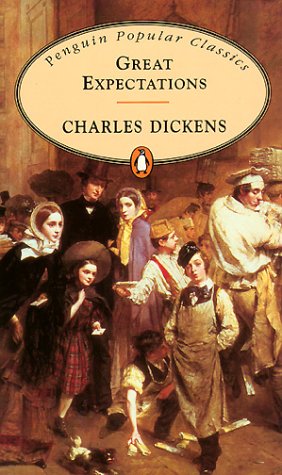 On the surface, Great Expectations appears very similar to David Copperfield. Both stories are centered around a young orphan and follows his trials and tribulations as he reaches adulthood. However, Pip is a hell of a lot more likeable than David and the characters surrounding Pip are more vibrant than those in David’s world. Humor plays a major role in Great Expectations while David Copperfield focuses on the harshness of reality. I’m not saying that Great Expectations is all sunshine and rainbows; it is absolutely not. The cruelties in Great Expectations, such as Pip’s sister’s brutal attack and Estella’s backstory, are particularly harsh and gruesome. But rather than dwelling on the gruesome parts of life, Dickens gives us humor to distract us from the harrowing parts of the novel.
Tough Love
One of my favorite motifs (I know I am sounding extra English teachery by using this word) in this novel is the way the female characters express their feelings. Each of the prominent female characters (Mrs. Joe Gargary, Miss Havisham, Estella) are just plain mean to the men in their lives. We first see this with Pip’s sister Mrs. Joe Gargary. Her husband, Joe, is perhaps one of the sweetest men I have come across in literature. Maybe he isn’t the sharpest tool in the shed, but that is no excuse for his wife to be so short tempered to him. Mrs. Joe Gargary is also cruel to Pip, her own brother! I found her to be one of my favorite characters. Her character traits, especially her mood swings, were exaggerated to heighten the humor. My favorite part, though, was that no matter how mean she was, Joe still loved her with all his heart.
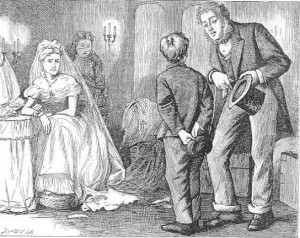
Miss Havisham is the epitome of a crazy old cat lady, but without all the cats. She sits in her room wearing her wedding dress from twenty years ago with all the clocks stuck at nine twenty because that is the exact moment her fiance left her. Miss Havisham isn’t exactly mean to Pip, but she shows no emotions except sadness and is never direct with him. She’s cold and lonely and feels spurned by all men simply because one hurt her.
 This brings me to her adoptive daughter, Estella. Miss Havisham raised her as a weapon against men. She raised her so she could not love or have any feelings. Therefore, using her beauty as a tool to break men’s hearts. Pip, of course, falls for Estella the moment he lays eyes on her and pines for her for most of the novel. Estella goes out of her way to make hurtful comments and to play with Pip’s mind. She makes him cry, lets him kiss her, flirts with other men in front of him. I first thought, why on earth would he like this girl? Yeah, she is pretty, but she has no soul. Then, I thought back to something a guy once said to me “sometimes guys are attracted to girls who are mean to them.” Makes sense. I am always a tad bit mean to the guys I like the most and they always seem to like this. Maybe they like a girl that can stand her ground and be a bit of a challenge. This isn’t only true with guys. As a girl (I don’t know why I feel like I need to clarify this), I do tend to be attracted to guys who aren’t afraid to tease me. However, if someone pushes too far, I tend to pull away. I could not put up with a male version of Estella; someone who purposely makes you want to feel bad about yourself.
It all comes back to plot
The main reason Great Expectations is better than David Copperfield is not the humor, but rather the plot. Great Expectations has a clear plot trajectory and if something was brought up earlier in the novel, it was used in a later point to serve a purpose. David Copperfield was structured very much like a biography with “this happened, then this happened, then this.” I understand this, but it was boring to read. In Great Expectations, everything is tied up at the end, though not necessarily in a pretty little bow. I don't ask for a happy ending, just an ending that serves a purpose. This ending left us on a hopeful note with Pip and Estella reuniting as friends. Romance could be possible, but it is uncertain. Personally, I like this ending; it is more realistic. We don't always get what we want and sometimes, if not always, friendships should be celebrated more than romance. Okay, I will stop being sappy now <3
Book 1 http://greatexpectationsnovel.weebly.com/uploads/2/3/0/1/2301863/936347_orig.jpg
Illustration http://www.charlesdickensinfo.com/wp-content/uploads/2012/07/Well_Pip_you_know_._._._._you_yourself_see_me_put_em_in_my_at-_ch._13-300x238.jpeg
