Rory must have been going through a Gothic romance and
feminine literature phase while she was at Stars Hollow High. We can see this
from the books she is carrying from her locker: The Second Sex, Madame Bovary,
Rebecca, and…Mistress of Mellyn. I was familiar with all the previous titles
Rory had read, as they are well-known classics; however, I had never heard of . It took quite a bit
of hunting to find myself a copy of this novel. I checked multiple book stores,
searched through several library systems, and even checked online resources.
Eventually, I found a used copy on Amazon for a dollar so I snatched it up. I
was instantly curious why Rory would have this novel on her shelf. It was not a
well known book nor was it by an author that was popular in our day and age.
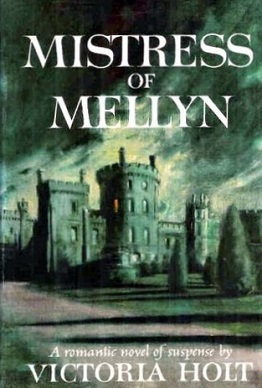
Mistress of Mellyn Upon
reading Mistress of Mellyn, I noticed
it was eerily similar to Rebecca (see
previous post) both in plot and tone. Of course, it was not exactly the same;
but it was enough for people to speculate it was actually written by Daphne Du
Maurier. Personally, I do not think it was as well written as any of Daphne Du
Maurier’s works. It was obvious that Holt was a fan and built off of du
Maurier’s success in the romantic genre to come up with her own story.
Upon
reading Mistress of Mellyn, I noticed
it was eerily similar to Rebecca (see
previous post) both in plot and tone. Of course, it was not exactly the same;
but it was enough for people to speculate it was actually written by Daphne Du
Maurier. Personally, I do not think it was as well written as any of Daphne Du
Maurier’s works. It was obvious that Holt was a fan and built off of du
Maurier’s success in the romantic genre to come up with her own story.
Mistress of Mellyn takes pace in an
upper class manner called Mellyn (obviously) which is coincidentally similar to
the Manderly, the manner house in Rebecca.
Both of these houses are “haunted” by the previous lady of the house who
mysteriously died, Alice in Mistress of
Mellyn and Rebecca. The action in both novels takes place roughly a year
after each woman died. However, the main character in Rebecca arrives to the house as the new lady of the house while the
main character in Mistress of Mellyn arrives
as the governess. Both narrators attempt to solve the mystery of the lady of
the house’s death and finds their place in life along the way. Rebecca ultimately does this better and
leaves a more thought provoking ending. Mistress
of Mellyn resolves every plot point with a neat and tidy bow. This is nice
to see, but not always satisfying.
 Even
though Mistress of Mellyn seems like
a lesser Rebecca, I did enjoy reading
it. I was excited to see that the main character’s name was Martha Leigh and
went by Leigh for the majority of the novel. It is very rare that my name is
used for a character in a novel, let alone for the protagonist. Martha was also
a name that is meaningful to me. My maternal grandmother’s name was Martha so
the combination of Martha Leigh immediately made me inclined to like the main
character. I could also connect to Martha Leigh because she was a governess and
I am a teacher. I could relate to how dedicated she was to her pupils and her
craft, but I could also connect to her personality. Whenever someone of a
higher level interacted with Martha Leigh, she would respond with “I’m just a
governess.” Whenever she was complimented, she took the humble approach and it
seemed like she could not see her worth. I am very similar in this nature. I
have always been the type to shy away from praise and let others share the
limelight. When someone gives me a compliment, it is easier to brush it off
with a joke than to just say thank you. It is often difficult for me to see my
own worth and this is something the main character struggled with. Everyone
else could see it, except for her. Sometimes it takes someone else to see a
different side of ourselves. We don’t always see ourselves the way others see
us. We are often hard on ourselves and hold ourselves to higher standards than
we do others. I am guilty of that crime. If anything, what I took away from
this novel is that I am never “just” a teacher; never “just” a student; never “just”
Leigh. I am all these things and I am more than enough and you are too.
Even
though Mistress of Mellyn seems like
a lesser Rebecca, I did enjoy reading
it. I was excited to see that the main character’s name was Martha Leigh and
went by Leigh for the majority of the novel. It is very rare that my name is
used for a character in a novel, let alone for the protagonist. Martha was also
a name that is meaningful to me. My maternal grandmother’s name was Martha so
the combination of Martha Leigh immediately made me inclined to like the main
character. I could also connect to Martha Leigh because she was a governess and
I am a teacher. I could relate to how dedicated she was to her pupils and her
craft, but I could also connect to her personality. Whenever someone of a
higher level interacted with Martha Leigh, she would respond with “I’m just a
governess.” Whenever she was complimented, she took the humble approach and it
seemed like she could not see her worth. I am very similar in this nature. I
have always been the type to shy away from praise and let others share the
limelight. When someone gives me a compliment, it is easier to brush it off
with a joke than to just say thank you. It is often difficult for me to see my
own worth and this is something the main character struggled with. Everyone
else could see it, except for her. Sometimes it takes someone else to see a
different side of ourselves. We don’t always see ourselves the way others see
us. We are often hard on ourselves and hold ourselves to higher standards than
we do others. I am guilty of that crime. If anything, what I took away from
this novel is that I am never “just” a teacher; never “just” a student; never “just”
Leigh. I am all these things and I am more than enough and you are too. Pictures
Book cover: https://images-na.ssl-images-amazon.com/images/I/51qWT1I6RiL._SY344_BO1,204,203,200_.jpg
Old Book cover:https://upload.wikimedia.org/wikipedia/en/5/58/Mistress-of-mellyn-victoria-holt.jpg


